12/18/25
Best of the West: Virtual fences protect cattle and wildlife; Washington battles flooding; SRS program passes; Geothermal business park; and the world’s oldest ice
.png)
The Western Governors' Association keeps you updated on the latest news in the West. Here are the top stories for the week starting December 15, 2025. (Photos courtesy of Adobe Stock Images, the University of Nevada, Reno, the Center for Oldest Ice Exploration, and the Office of Washington Governor Bob Ferguson).
More than 620,000 miles of fences carve up western landscapes – far more than the distance to travel to the moon and back.
While ranchers in the West have built and moved fences for hundreds of years to contain their livestock, new technologies are beginning to remove the need for physical fences, with a host of potential benefits for ranchers, wildlife, and landscapes.
GPS collars and ‘virtual fencing’ are starting to spread to ranches in our region, after being popularized in New Zealand in past years.
Ranchers can affix GPS collars to their herd, which give cattle a beep if they head too far in the wrong direction, and a shock if they continue. Apps and online programs then allow landowners to draw virtual boundaries and change them when necessary. This cuts down on the tough labor and high costs that are required to move barbed wire and other physical fencing. A single mile of new fence can set a rancher back tens of thousands of dollars.
They can also keep cattle safer, and alert ranchers to the behavior of their herd. If wranglers find something in their pasture that they need to keep cattle away from, they can quickly fence off that area. Similarly, GPS collars can help keep cattle away from known locations of bears or wolves, which can cut down on dangerous and costly encounters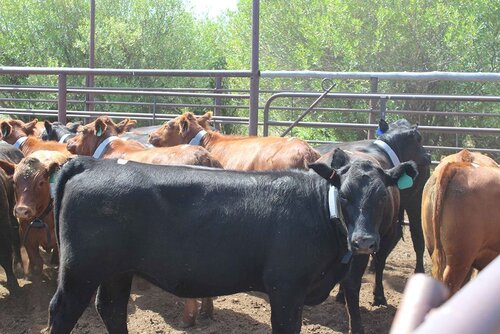 with predators.
In many cases, virtual fences can also benefit wildlife. Every year, countless animals are blocked from their migration routes, prevented from accessing food, or tangled up in fences. Virtual fences can open up safer landscapes to wildlife and prevent more headaches for ranches.
“It’s a huge help to us,” Dustin Taylor, a ranch manager in Wyoming, told the New York Times. “Our cows won’t leave, but the elk will.”
Researchers at the University of Nevada, Reno, have been testing GPS collars across tens of thousands of acres of rangeland in Nevada recently. They found that virtual fencing allowed for more efficient grazing and better ecological balance on the landscape. Ranchers could steer their herd toward cheatgrass or other non-native grasses, which helped boost native plant growth and cut down on fire-prone and nutrient-depleting cheatgrass. At one site, the targeted grazing reduced cheatgrass biomass from 400 pounds per acre to 100 pounds per acre.
One obvious drawback of implementing GPS collars is the cost, as the systems can cost tens of thousands of dollars. Increasingly, however, conservation groups, nonprofits, universities, and state and federal programs are stepping in to help ranchers try it out.
An unexpected source of funding has also recently come from the carbon credit company Kateri. The company is paying for cattle ranches to be equipped with GPS fencing, which they use to sell carbon credits based on their ability to prevent overgrazing, boost native plant growth, and generally create healthier grasslands. They are able to quantify the increased amount of carbon stored in the soil, and sell credits based on that figure.
For more on rangeland management, check out Idaho Governor Brad Little’s 2022 WGA Chair initiative report, Working Lands, Working Communities. Also check out WGA Policy Resolution 2024-02, National Forest and Rangeland Management.
Washington battles flooding: more than a week of heavy rain has caused record flooding in Washington. A sequence of storms dumped nearly two feet of rain in the Cascade Mountains, causing rivers to spill over and.jpg) levees to breach.
levees to breach.
Governor Bob Ferguson said Tuesday that first responders have completed at least 629 rescues and assisted 572 evacuations.
Governor Ferguson issued an emergency proclamation to activate state cash and benefits assistance programs and directed $3.5 million in emergency funds for relief and recovery. Washington has also received a federal emergency declaration and is getting support and resources from surrounding states.
“Our state is in the middle of a historic crisis, and it remains unpredictable,” Governor Ferguson said Tuesday. “We are not in the clear yet and Washingtonians must remain vigilant to stay safe. We are working around the clock to respond to this disaster. We will provide impacted communities the assistance they need as fast as possible.”
Rural school funding: last week, Congress passed the bipartisan Secure Rural Schools Reauthorization Act, which Western Governors have long supported and consistently advocated for. The program provides funding to support essential services like education, emergency response, land management, and public safety to counties with non-taxable land administered by the U.S. Forest Service.
Last month, Western Governors collectively updated and approved a bipartisan policy resolution related to the SRS program and the Payments in Lieu of Taxes program.
“These payments are vital to providing state and county public goods and services, such as roads, wildfire emergency response, and wildlife and natural resources protection in communities adjacent to federal lands,” reads the policy resolution.
Geothermal business park: as the coal industry fades in the small Colorado town of Hayden, the community is looking to new opportunities to boost its economy. It’s finding it with geothermal, as the town is developing a new 58-acre business park that’s heated and cooled by geothermal.
Businesses that move in will benefit from cheap energy bills, thanks to the hyper-local geothermal network.
Hayden's city manager Matthew Mendisco sees geothermal as a long-term bet for the area. “You could generate those megawatts forever,” he told Canary Media. “You’re never going to have to be reliant on the delivery of coal or natural gas. … You drill it on-site, the heat comes out.”
For more on geothermal in the West, check out the Heat Beneath Our Feat initiative report from Colorado Governor Jared Polis’ term as WGA Chair.
World’s oldest ice: researchers from Oregon State University and the University 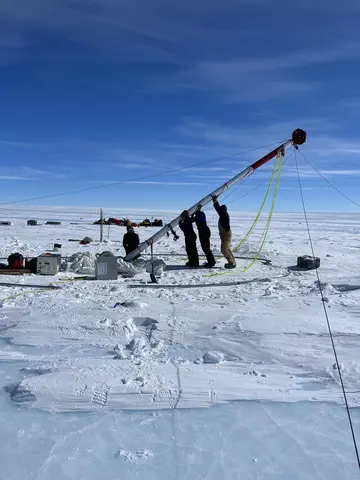 of Washington recently discovered the oldest ice sample ever dated on the planet.
Using clues from gasses trapped within the sample, the team was able to pinpoint its age – six million years old. They discovered the sample in Antarctica, which required drilling 300-600 feet into the ice sheet.
The cores give scientists a new window into Earth’s climate patterns, including historical temperature and CO2 levels.